Compliance Nightmares: Five Campaign Finance Mistakes Committees Keep Making
— March 4, 2026 — 4 min read
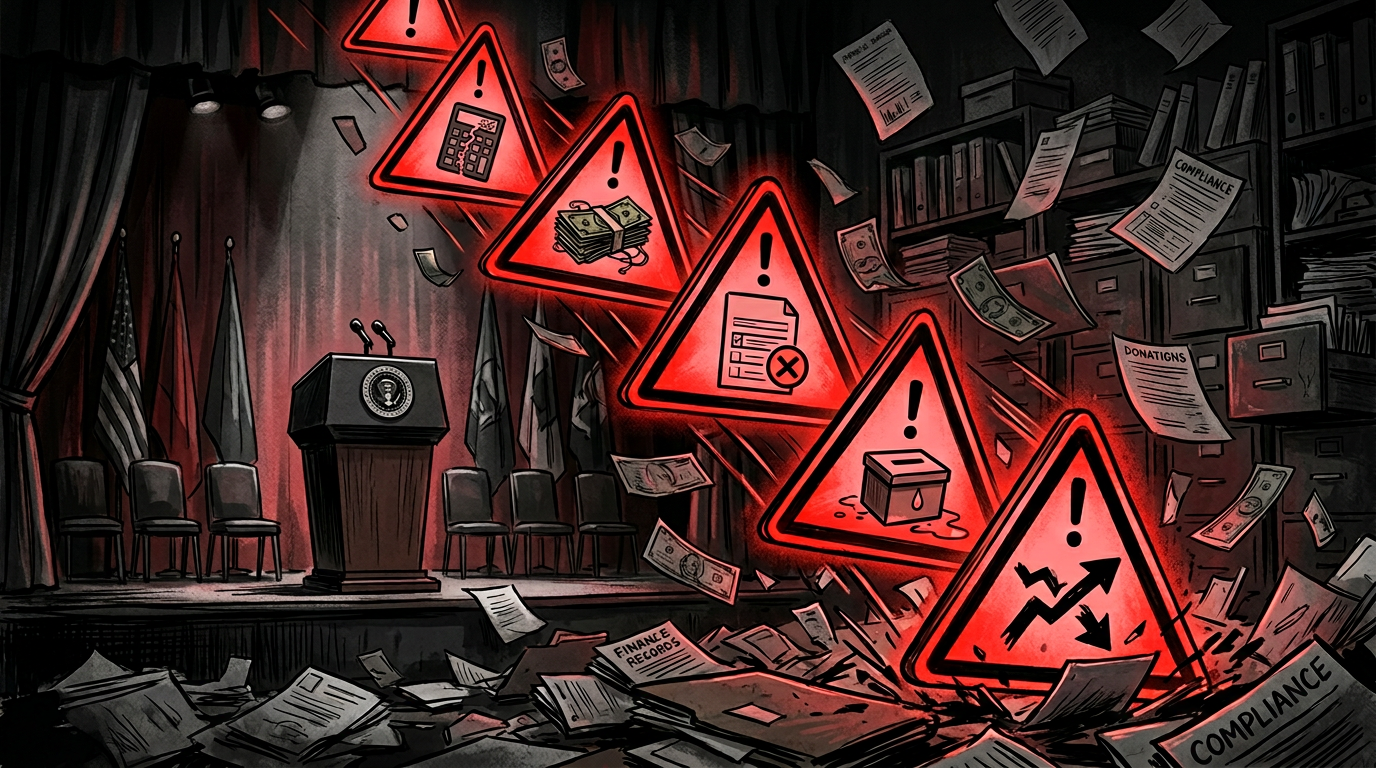
Nobody Plans to Violate Campaign Finance Law
Compliance disasters never start with someone deciding to break the law. They start with shortcuts. With "we'll fix it later." With a treasurer who is also the candidate's cousin and has never opened the FEC campaign guide.
Here are five ways committees get into trouble. Each pattern shows up in FEC enforcement matters (MURs) and IRS guidance; the scenarios and dollar figures below are illustrative composites, not specific cases. Each one is preventable at intake.
Mistake 1: The Straw Donor Scheme
A congressional candidate's finance director asks five friends to each give the maximum, promising to reimburse them from the candidate's personal funds. That's a contribution in the name of another, prohibited outright by 52 U.S.C. 30122, and it's one of the few campaign finance violations the Justice Department prosecutes criminally instead of leaving to the FEC's civil process.
The committee has to refund the money and amend its reports. The finance director is looking at a criminal referral. The candidate reads about it in the local paper the week before the election.
The prevention is a two-minute report. Before each filing, sort the period's contributions by address and by employer and look at anything where several near-max gifts share a household and a date. The fields are already on every contact record (employer, occupation, address), and that filter is exactly what an FEC analyst will run later.
Mistake 2: The Missing Employer Records
A state party committee takes in a few hundred thousand dollars in itemizable contributions without collecting employer and occupation for most of the donors. When the reports get reviewed, the committee can't show "best efforts" to collect the information.
Best efforts has a specific meaning under 11 CFR 104.7: the request printed on the solicitation, one follow-up within 30 days, and a note of the attempt. Without that record, the committee is exposed to a civil penalty in a MUR and has to amend every affected report.
Put employer and occupation on the donation form, send one follow-up within 30 days, and search for gifts still missing those fields before each period closes.
Mistake 3: The Personal Credit Card
A campaign manager books a $15,000 venue on her personal card, planning to be reimbursed by the campaign. She is, six months later.
Under 11 CFR 116.5 a staff advance is fine only if the committee reimburses it within 30 days, or within 60 days of the credit card statement's closing date. Six months late, the $15,000 advance became an in-kind contribution more than four times the individual limit ($3,500 per election for 2025 to 2026, per the FEC contribution limits table). The committee has to refund the excess and amend its reports, and both the committee and the manager are exposed in a MUR.
Write the policy down: no personal advances, and a campaign card for every campaign expense. If someone has to front money in an emergency, the reimbursement goes out inside the 116.5 window.
Mistake 4: The Nonprofit That Played Politics
A 501(c)(3) educational organization sends an email to its donor list that includes the sentence: "Vote for candidates who support education funding this November." Seven words.
Endorsing candidates is an absolute prohibition for a 501(c)(3). The IRS can assess excise taxes on the political expenditure under IRC 4955 and, in serious or repeated cases, revoke exemption. Revocation would put every foundation grant that requires (c)(3) status at risk, and the reinstatement fight lands on the board.
Every external communication gets read by counsel or a compliance officer before it goes out, and every staff member who can hit send knows the campaign intervention rule.
Mistake 5: The Forgotten Termination Report
A House campaign wins, the candidate is sworn in, and the volunteer treasurer moves on. Nobody files the termination report (Form 3 marked as a termination, showing no cash on hand and no debts), so reports keep coming due. Each missed report draws an administrative fine, and the fine letters become opposition research two years later.
Keep a filing calendar that runs past election day, with a dated plan for winding the committee down and a named person who files the last report.
The Common Thread
Every one of these failures shares a root cause: compliance was treated as an afterthought instead of infrastructure. The committees that stay out of MURs collect employer and occupation at intake, reimburse staff advances inside the 116.5 window, and keep a filing calendar that runs past election day.
A MUR follows the candidate into the next cycle and the treasurer into the next job. Fix intake now.
Tags: campaign finance, compliance, FEC enforcement, political committees, 501c3
 FEC Compliance in 2026: The Filing Calendar, the $3,500 Limit, and Three Treasurer Errors
 Political Fundraising Texts: TCPA, Consent, P2P vs Automated, and Opt Outs
 PACs, Super PACs, and Party Committees: A Fundraiser's Field Guide