Donor Segmentation: The 5 Groups to Track First
— January 6, 2026 — 8 min read
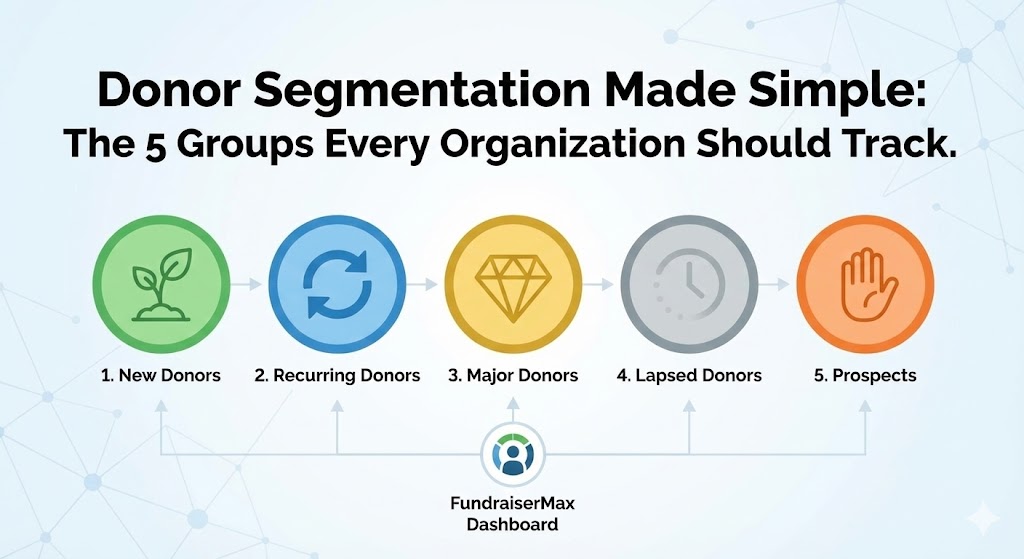
A year-end appeal that goes to the whole file sends the same "thank you for your first gift" line to a donor in her ninth year of monthly giving. She notices. Five groups and five fields fix most of that.
When every supporter gets the same appeal, you end up with new donors who never learn what their gift changed, loyal donors who feel overlooked, lapsed donors with no reason to come back, recurring donors getting first-time-donor copy, and top supporters who'd do more if anyone asked them differently.
Five groups cover most of the file. Add more only once each of the five has its own email and its own number you check monthly.
What Donor Segmentation Is
Donor segmentation is grouping supporters by what they did (or didn't do) so you can send the right message at the right time.
The Five Groups
1. New donors (first gift)
Gift count of one, with the first gift inside the last 30 to 90 days.
What they need is proof the gift was used, inside a week. The goal is a second gift, fast.
The plan:
- Days 0 to 2: thank-you and receipt
- Days 3 to 7: a proof-of-impact update (a short story, a photo, or one clear number)
- Days 10 to 21: a small second-gift ask or a monthly option
Subject lines that fit: "You made this possible", "Quick update since your gift", "Can we show you what happened next?"
Email template:
Hi {{FirstName}},
Thank you again for supporting {{OrgName}}. Because of you, {{impact outcome in plain language}}.
Here's a quick update: {{1 to 2 sentences of impact proof}}.
If you'd like to keep this going, would you consider a second gift of {{amount}} to help us {{specific next step}}?
{{donation link}}
Gratefully,
{{Name}}
2. Repeat donors (two or more gifts)
Gift count of two or more, or at least two gifts in the last 12 months.
What they need is a thank-you that shows you noticed it was the second gift. The goal is a larger gift and a closer connection.
Send a thank-you that names the loyalty ("thanks for giving again"), the occasional insider update (milestones, quick wins, what's behind the scenes), and upgrade asks tied to a real outcome rather than guilt.
Subject lines that fit: "You've been showing up, thank you", "Here's what your support is building", "A bigger step (if you're able)".
SMS template (consented numbers only):
Hi {{FirstName}}, you've supported {{OrgName}} more than once, and we notice. Thank you.
We're working on {{priority}} this week. If you're able to give {{amount}}, it gets us {{specific outcome}}: {{link}}
3. Lapsed donors (used to give, then stopped)
Pick one definition and keep it: no gift in the last 12 months (common), or 18 months for slower cycles.
What they need is a reason to come back that doesn't read as a "where'd you go?" scolding. The goal is a low-friction welcome back.
The reactivation sequence:
- A warm update on what's changed since they last gave
- A soft ask ("if you're able") with a clear purpose
- A preference check ("do you still want updates?"), which helps deliverability too
Subject lines that fit: "A lot has changed since you last helped", "Can I show you something encouraging?", "Still want updates from us?"
Email template:
Hi {{FirstName}},
It's been a little while, and we wanted to share an update. Since you last supported {{OrgName}}, {{1 to 2 sentences: progress and what's still needed}}.
If you're open to it, a gift of {{amount}} today would help us {{specific outcome}}.
{{donation link}}
And if your priorities have changed, no problem. Would you rather receive fewer updates or pause messages entirely?
Thank you for what you've already made possible,
{{Name}}
4. Recurring donors (monthly supporters)
An active recurring gift, at any interval.
What they need is reassurance the steady gift matters, and appreciation without constant extra asks. The goal is to keep the plan active and the card current.
Send a monthly or quarterly impact note for the steady team, the occasional unprompted thank-you (a short video, a photo, a note from staff), and one upgrade option a year (a small increase to the monthly amount).
Don't treat them like everyone else and ask for one-time gifts every week.
Subject lines that fit: "Your monthly support is doing real work", "A note for our steady supporters", "A small optional upgrade (only if it's easy)".
Email template:
Hi {{FirstName}},
Because you give monthly, we can plan ahead instead of reacting. This month, your support helped {{impact}}.
If you ever want to increase your monthly gift by {{small amount}}, it would add {{clear outcome}}. Either way, thank you for being one of our steady supporters.
{{manage recurring link}}
5. High-impact donors (top supporters)
Pick a threshold that fits your file: top 10 percent by lifetime giving, or at least your own major-gift threshold in the last 12 months, or the highest average gift.
What they need is a phone call and a personal email, never the mass appeal. The goal is to keep them, grow the gift, and get them on the phone once a year.
Send personal check-ins that aren't always an ask, early access to plans and priorities, and specific, scoped opportunities ("this would fully fund X").
Subject lines that fit: "A quick, personal update", "Can I run something by you?", "A specific need I think you'll care about".
Email template:
Hi {{FirstName}},
I wanted to personally share something you helped make possible: {{impact story}}.
We're planning our next steps for {{time period}} and one priority is {{need}}. If you'd be open to it, I'd like to share the plan and hear your thoughts.
Would you be willing to talk for 10 minutes this week?
{{Name}}
The Five Fields You Need
To run these five groups you need five fields:
- Last gift date
- Gift count (lifetime)
- Total giving (lifetime or last 12 months)
- Recurring status (an active recurring gift)
- Gift source (online, event, peer-to-peer, email, text)
Those fields are already on every record in FundraiserMax (last gift date, gift count, lifetime total, and source on the contact; the recurring flag on the gift), and a smart segment on gift count or last gift date is most of the build.
When a Donor Fits Two Groups
Donors overlap (a high-impact donor can also be recurring). Use a priority order so the messaging stays consistent:
High-impact, then Recurring, then New, then Repeat, then Lapsed.
If someone is high-impact, they get the high-impact experience first.
What to Automate and What to Keep Personal
Automate these:
- The new-donor thank-you and impact follow-up (a drip sequence)
- The lapsed-donor update and soft ask
- The recurring-donor monthly impact note
- Membership, by building each group as a smart segment on gift count and last gift date and re-applying the rules before each send
Keep these personal:
- High-impact stewardship
- The first touch after a large or meaningful gift
- Sensitive moments (crisis response, memorial gifts)
The Five Metrics That Say Whether It's Working
One metric per group:
- New donors: second-gift rate within 30 to 60 days
- Repeat donors: upgrade rate (share whose average gift rose)
- Lapsed donors: reactivation rate
- Recurring donors: monthly churn
- High-impact donors: year-over-year retention plus upgrade count
You don't need a big dashboard. A monthly check is enough.
Common Mistakes
- Creating 20 segments and using none of them. Start with five and earn complexity later.
- Retagging donors by hand. A rule-based segment on gift count and last gift date moves a donor from new to repeat to lapsed when you re-apply the rules, so the only manual step is running it before a send.
- Ignoring consent and channel preferences. If you text, get consent first and honor STOP the same day.
- Asking recurring donors for one-time gifts too often. If you ask, do it rarely and with care. Most of the job is stewardship.
- Treating lapsed donors like strangers. They already supported you once. Speak with gratitude, not suspicion.
Three Segments to Add Later
Once the five are running, add these:
- Event attendees: follow up with photos, highlights, and one clear next step
- Peer-to-peer fundraisers: thank them, then invite them to run another campaign
- Volunteers and advocates: give them shareable actions as well as donation asks
This Week's To-Do List
- Define the five segments with simple rules
- Tag donors (new, repeat, lapsed, recurring, high-impact)
- Write one message per segment (start with email)
- Set one drip sequence (start with the new-donor thank-you and impact note)
- Review results monthly and improve one message at a time
Tags: donor segmentation, segmentation, retention, donor retention, recurring giving, donor stewardship, fundraising strategy, best practices
 Donor Advised Funds and Nonprofits: How to Earn More DAF Grants in 2026
 Recurring Giving for Nonprofits and Campaigns: Setup, Retention, and Compliance
 Donor Retention: The Line Item Missing From Most Fundraising Budgets